Things kids must know about natural disasters
Flood is something that I dread since I was in grade school. I knew what its like to stay in a flooded area for days since we live near Laguna Lake. Water level rises during a heavy downpour. I remember two particular typhoons wherein my family was forced to vacate our house to transfer to our neighbor with an elevated house.
The highest flood in our place if I may recall reached as high as 4 feet, a far cry from the flood that submerged several areas in the eastern part of the National Capital Region. I’m not sure how the experience had affected me or if it has ever affected me at all.
My good friend Pehpot share her traumatic experience with Ondoy. Their house was one of thousands of houses affected by flood water in Pasig causing traumatic experience to her family especially to her little boys. She said the mere sound of rain cause her young ones to fret. I hope they’ll recover from that bad experience soon.
Here’s a bit of information about teaching kids how to respond during and after emergency situations.
The child’s sense of security is threatened and he/she will find this confusing especially if it happens when the parent is not at home. Making them cope well with these calamities would be a big help.
Children learn to take their cues from the adults in their lives. So, as parents, you need to acknowledge the reality of the situation to your child so that he is assured that everything can be taken cared of. Assure them that their family and friends will take care of them no matter what happens.
You need to encourage them to express whatever feelings they may be repressing as a result of the trauma of the calamity. Strategies such as drawings and music or drama can bring out their fears in a creative way. There are activities that should help your children to apply problem-solving skills to these stressors.
Calamities may not happen often but when they do, it is better to be prepared and able to respond well. Some children may be at a risk of post-traumatic stress disorder. Some may be irritable, others may do the opposite and just sleep their stress away. But if you help them cope with it, then they normally will be able to bounce back.
For school-age children some of the more common and practical solutions would be classroom discussions and small group counseling. A referral system may be put in place so that there will be a parent-referral system that could help you and the kids.
Another strategy that can be done is to help children to recall past ways with which they coped with the stresses in their lives. A mechanism also needs to be in place for self-referral and parent-referral of students.
Remember that you need to be strong for your children. If they see that you are able to cope well with the situation, they will also learn how to deal with the event.
Be very responsive to the way you deal with the relocations that will entail along the way. Changing locations will be a stressful one especially when the child is attached to his home.
Source: People’s Journal and How to do things dot com.
More volunteers needed for typhoon victims
Even before thousands of typhoon victims could recover from the devastation brought by Ondoy, another super typhoon has already entered the Philippine area of responsibility. We can only pray typhoon Pepeng would not cause as much damage as Ondoy…
Aside from volunteers who will help in the repacking of goods, social welfare and development authorities are requesting assistance from individuals, group of friends, corporations and organizations and even families who have the desire to contribute knowledge, skills, time and resources.
Authorities are needing the services of people (elder volunteers) who can provide advice and comfort to victims of disaster. Experts call it stress debriefing session.
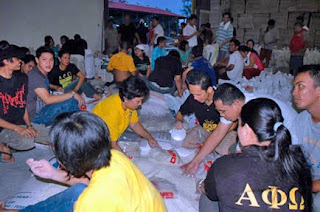
From what I’ve heard about disaster victims, it may take months or years before survivors can fully recover from the physical and emotional trauma caused by the tragedy.
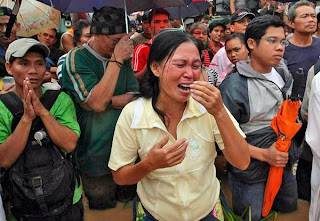
Stress debriefing session allows survivors to ventilate or pour out his or her feelings and fears to lessen his emotional burden.
For those who are willing to serve as volunteer may visit www.dswd.gov.ph. Click the icon on Bayanihang Bayan Volunteer Registry to know about the program and fill-up the DSWD Volunteer Registration Form (VRF).
The registry of volunteers is part of the national data base of volunteers for disaster operations and facilitate the deployment of appropriate volunteers to an emergency or disaster operation.
Now, do you have what it takes to be a volunteer?
ANGEL SURVIVES HELL
ANGEL’S mother may have wronged her repeatedly, but Angel has remained a child who always longs for a parent’s comforting embrace, especially in trying periods of her young life.
The 15-year-old Angel is a child of sorrow. Not only was she battered, she has also been raped allegedly by her stepfather for three years, since she was 11 until she turned 13.
The girl was able to testify in court and has tried hard to pursue her case.
Angel is apparently coping with her traumatic experience.
Social workers who attended Angel at the Marilac Hills in Alabang, Muntinlupa, the half-way house maintained by the Department of Social Welfare and Development (DSWD) for victims of child abuse, said that coping is critical because, without it, “no amount of rehabilitation or counseling could help the person.”
“When the child failed to cope from the trauma during her younger years, it’s possible that it would manifest when she becomes an adult,” the said.
Coping up with the trauma, social workers said, varies for each victim of abuse.
Sometimes, the conviction of the abuser sets the victim free. But there are those who still suffer from guilt despite the conviction of the suspect.
A majority of the clients housed in Marilac have on-going court cases. Their ages range from seven to 17 years old.
Inspiration
The brave girl that she is, Angel serves as an inspiration to other abused children at the half-way house for abused children in Marilac Hills.
She advised other children who may be suffering from abuse — or other forms of exploitation — to seek help from elders.
Parents may also learn from Angel’s bad experience, and she advises them to protect and love their children — always.
Terror and trauma
Children need not face their abusers while a case is being heard in court. A child’s testimony in video is now acceptable in court.
There are only 14 so-called “investigation studios” in the country, most of them in Metro Manila. There, the children can relate their experiences without feeling traumatized again.
This is because a trained social worker provides counseling along the way.
Children in half-way homes are taught to be independent until they are ready to face the world at the age of 18, says a social worker at the half-way house.
Other institutions will find a job for these children or train them in income-generating activities.
Social workers are there for as long as the children need counseling — or even just someone to talk with.
This is part of my article “Incest with an Angel” published by People’s Tonight on April 17, 2006.
My post for the Run and Rally to Stop the Silence (of Child Sexual Abuse) Bloggers Unite


 ShareThis